
The hose end is the most "looks alike, built different" part in performance plumbing.
For wholesalers and distributors, being able to explain the differences to customers isn't just sales skill — it's professional trust.
This article lays out a complete technical map of hose-end types, from the classic Swivel to the Quick Release.
A classification framework first
Setting brands and sizes aside, a hose end is really about two things: how the hose is held, and how it seals. Along those lines, the mainstream methods fall into five families:
1. Flare (37°) — a 37° cone makes a metal-to-metal seal; the threads only clamp.
2. Ferrule — a ferrule/sleeve compresses the hose onto the fitting stem; common for PTFE hose.
3. Push-on / Barb — a barbed end the hose pushes onto; no tools.
4. Cutter — a cutter sleeve "bites" into the hose outer layer during assembly to lock it.
5. Crimp — a dedicated tool crushes the sleeve into a permanent connection.
On top of these, two overlays apply: Swivel lets the fitting rotate 360° for easier routing and install; Quick Release / Quick Connect lets the line be connected and disconnected quickly.
Type-by-type breakdown
Swivel
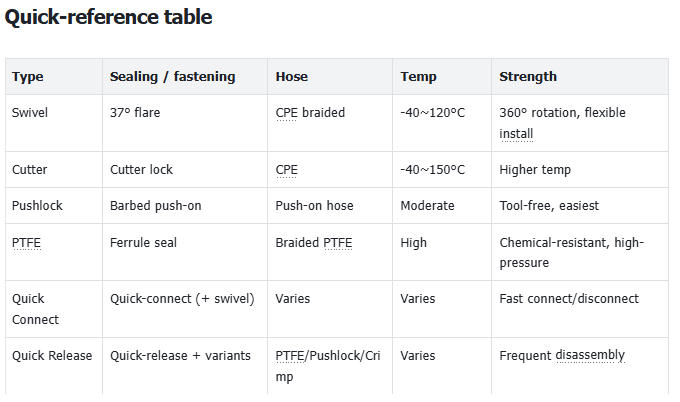
The classic performance fitting. The core is 360° rotation plus a 37° flare seal (UNF threads), paired with stainless/nylon braided CPE hose. The swivel frees up install angles — especially useful in tight engine-bay routing. Typical working range -40°C to 120°C.
Cutter
During assembly, a cutter sleeve "bites" into the hose to lock it — another locking method for rubber-class hose. Its standout is a higher temperature range (up to 150°C), for lines that run hotter.
Pushlock
A barbed-end fitting the hose simply pushes onto — no clamp or ferrule, the easiest to assemble. Used with dedicated push-on hose, for low-to-medium-pressure fuel, oil, and coolant.
PTFE
Ferrule-style seal with braided PTFE hose: the strongest chemical resistance (E85/methanol/brake fluid), near-zero permeation, high temperature and pressure — the default for high-pressure fuel and racing. Pressure ratings run higher (e.g., AN4 working 4000 PSI).
Quick Connect
Built around fast connect/disconnect. Industrially it appears as ball-and-sleeve, push-to-connect, cam-lock, and more; in automotive performance lines it's often combined with a Swivel.
Quick Release
A quick-release base with material/seal variants — commonly Quick Release PTFE, Quick Release Pushlock, and Quick Release Crimp — for lines that need frequent disassembly or special sealing.
BJR's full-range coverage
The hard part isn't finding a fitting — it's getting every type and size from one supplier. BJR's hose-end range covers the whole map:
-
Swivel / Cutter — the CPE rubber-class option, 360° swivel, 37° flare;
-
Pushlock — the tool-free push-on option;
-
PTFE — the high-pressure, ethanol-resistant option;
-
Quick Connect Swivel, Quick Release PTFE / Pushlock / Crimp — the quick-connect/quick-release options.
The whole range uses the 37° flare standard, spans AN4 through AN20, and supports custom colors on request. For distributors, that means delivering a complete hose-end knowledge framework and a complete catalog together — selling both the product and the credibility.
If you'd like a forwardable selection guide or technical training material, we're happy to help.

