Why AN Fittings Leak: 5 Causes and a Prevention Checklist for Distributors
In high-performance fuel, oil, cooling, and brake plumbing, the AN fitting — a 37° flare connection — is the de facto standard. Its reliability rests on one simple engineering principle: a metal-to-metal cone seal. But that same principle means that when installation goes wrong, leaks are almost inevitable. For wholesalers and distributors, every installation-related leak eventually comes back as a return, a complaint, or a lost customer.
This article breaks down the five most common causes of AN fitting leaks and provides a checklist you can forward directly to end users — so you can cut after-sale costs and build trust.
Why AN fittings seal (and why threads don't)
AN fittings follow the SAE J514 standard and use a 37° flare. During assembly, the lock nut draws the flared cone of the hose end against the 37° seat of the adapter, and the line contact between the two 37° surfaces creates a high-pressure metal seal. The threads only provide clamping force — they do not seal. This is the starting point for understanding every leak: sealing depends on the quality of contact between the two cones, not on how hard you crank the nut.
It also means that a metal-to-metal seal needs no thread sealant when assembled correctly — and that wrapping threads with tape or adding more torque cannot rescue a poor cone fit.
The 5 causes of AN fitting leaks
Cause 1: Wrong torque (over- or under-tightening)
Over-tightening deforms the fitting or the mating surface and compromises the seal; under-tightening leaves the two cones insufficiently compressed and fluid escapes. This is the most common — and most overlooked — installation error. The fix is a torque wrench set to the manufacturer's specification, not "feel."
Cause 2: Flare-angle mismatch (37° vs 45°)
AN/JIC fittings use a 37° flare, while common SAE brake lines use 45°. The two angles are not interchangeable: threading a 37° fitting onto a 45° flare will leak at the flare. Always confirm the line end is 37°, not 45°.
Cause 3: Thread-type confusion (AN vs NPT)
AN is a straight thread that seals on a cone; NPT is a tapered pipe thread that seals on the thread flanks. The two sealing methods are fundamentally different. Mixing them, or using the wrong adapter, is a classic source of "it threads in but it always leaks."
Cause 4: Dry assembly (no lubrication)
In reusable fittings, assembling without any lubrication is known as dry assembly. It increases thread friction, prevents proper seating, and produces a weak connection that leaks from day one. Applying a small amount of compatible assembly lubricant to the threads and cone is a low-cost, high-impact step.
Cause 5: Damaged or contaminated sealing surface (bad flare, corrosion, cracks, debris)
An irregular flare, a scratched or corroded cone, a hairline crack, or trapped debris will all defeat a metal seal. Long-term exposure to high pressure, extreme temperatures, or corrosive fluids can also produce micro-cracks in an otherwise sound fitting. Cleaning and inspecting the sealing surfaces before installation is the first line of defense.
The installation checklist (share it with your customers)
-
Check the angle — confirm the line end is 37° (AN/JIC), not 45° (SAE).
-
Check the thread — distinguish straight-thread AN from tapered NPT, and confirm the adapter.
-
Clean the sealing surfaces — remove debris, oil, and burrs from the cone and threads.
-
Inspect for damage — look for scratches, cracks, and corrosion on the flare, cone, and threads.
-
Lubricate — apply a small amount of compatible assembly lubricant to threads and cone.
-
Align by hand — start the fitting by hand and confirm there's no cross-threading or misalignment.
-
Torque to spec — use a torque wrench (see the table below); avoid over- or under-tightening.
-
Pressure-test — pressure/leak-test the assembly before it goes into service.
Aluminum AN fitting torque reference (in inch-pounds)
Reference values drawn from published aluminum fitting torque specs (Van's Aircraft, Holley, Factory Five, and others). Individual manufacturers may differ slightly; the manufacturer's spec is authoritative. When mating aluminum to steel, use the aluminum torque.
| Size | Min | Max |
|---|---|---|
| -04 | 100 | 140 |
| -06 | 150 | 195 |
| -08 | 270 | 350 |
| -10 | 360 | 430 |
| -12 | 460 | 550 |
| -16 | 700 | 840 |
| -20 | 850 | 1020 |
How BJR helps your customers avoid these mistakes
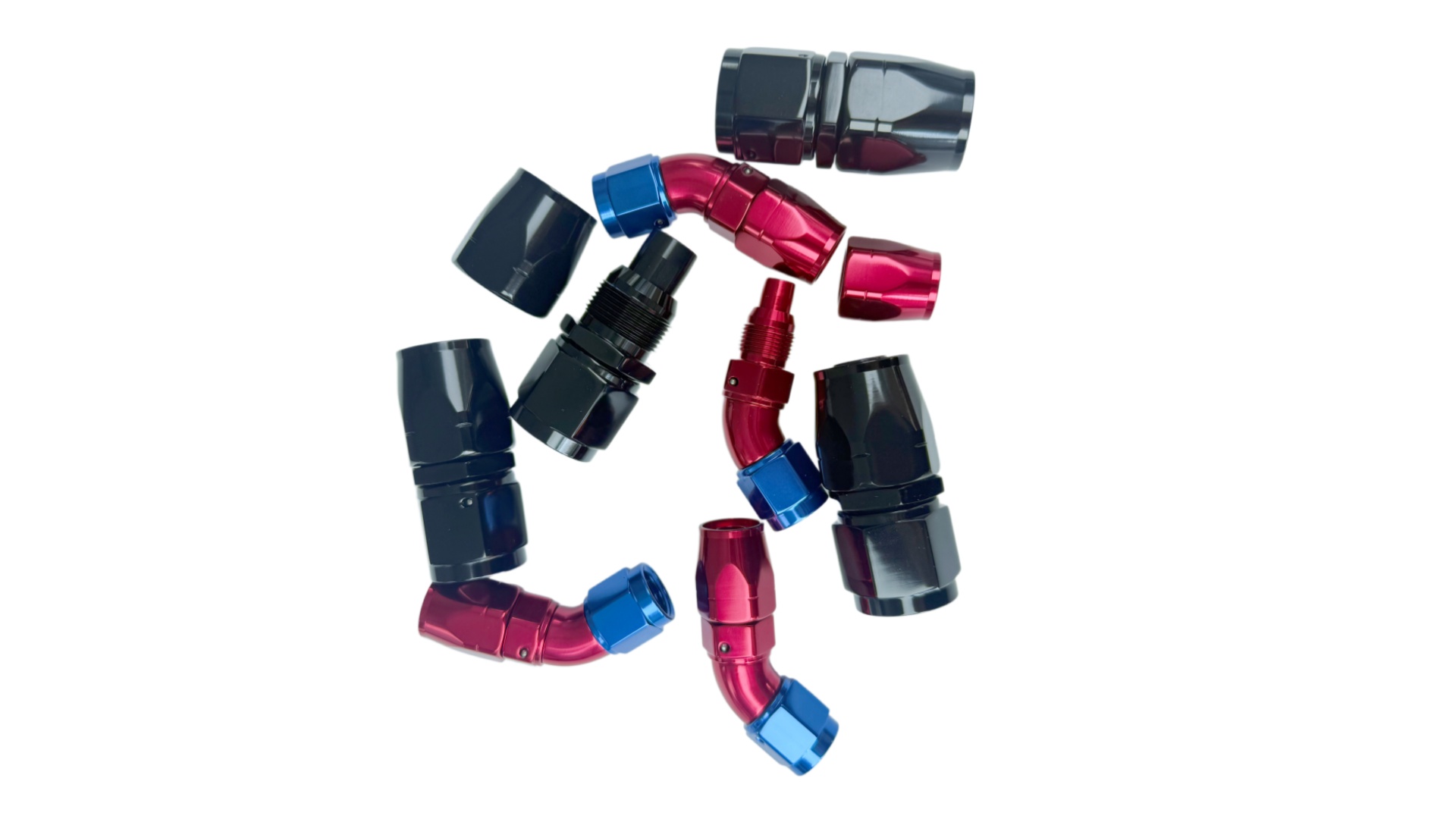
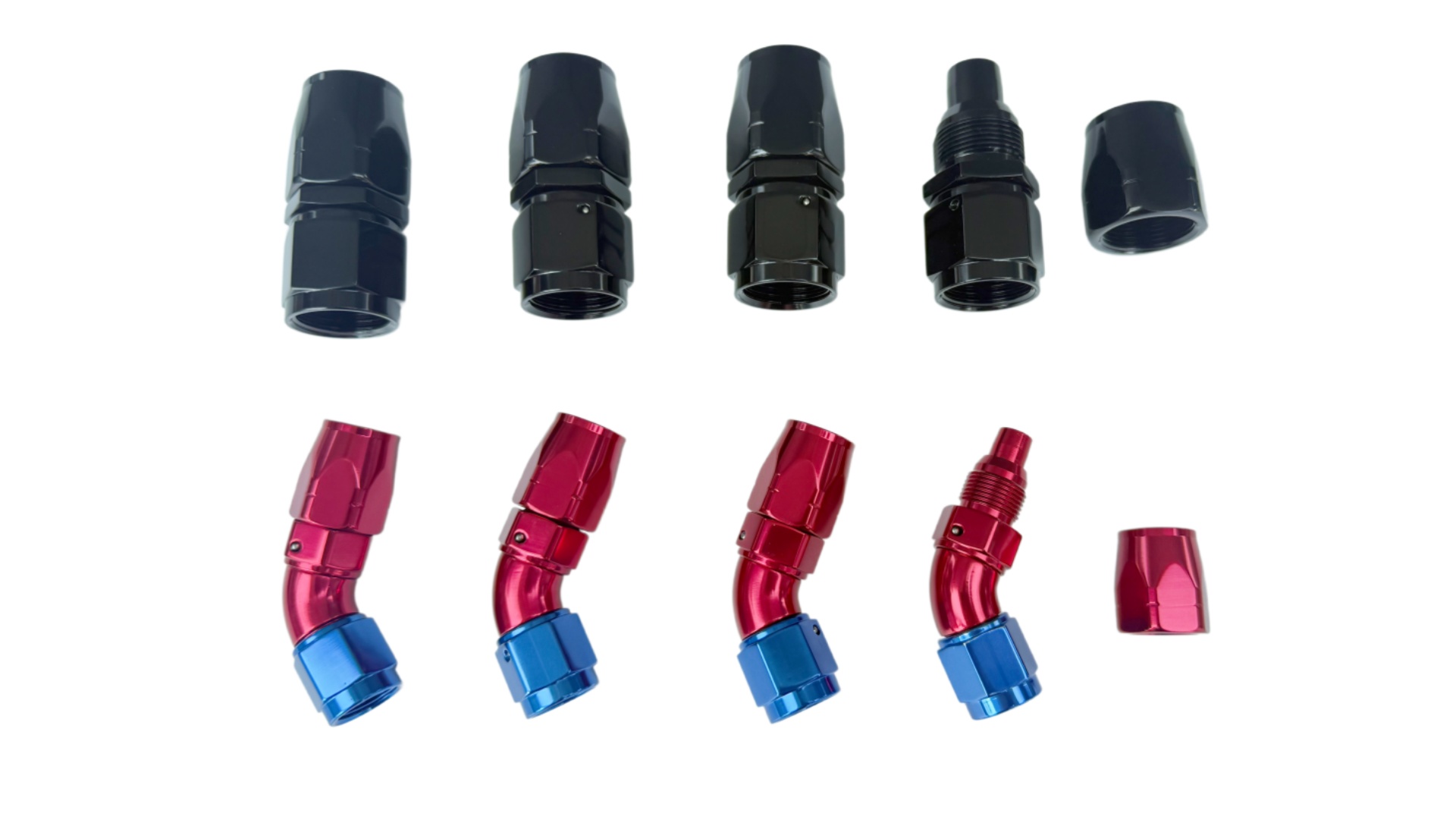
As a specialist manufacturer of performance hose ends, BJR reduces leak risk at both the design and quality-control level. The entire range uses a 37° flare (AN Standard), fully compatible with the mainstream AN fitting ecosystem, and every component passes multi-stage testing from CNC precision machining through final leak checks. With full-type coverage — Swivel, Cutter, Pushlock, PTFE, Quick Connect, and Quick Release — and sizes from AN4 to AN20, BJR gives distributors the ability to specify the right fitting for each fluid, pressure, and installation scenario, preventing the "wrong choice, wrong install, leak" problem at the source.
If you need support specifying or troubleshooting for your customers, we're here to help.